One generation shall commend your works to another, and shall declare your mighty acts
(Psalm 145:4)
Not many people know that April 10 was International Nana Day. Today I would like to honor the memory of my husband’s great-grandmother, Palma Dulcenome Alberico, whom my husband never had the joy of meeting. Pieces of Palma’s life story linger in the memories of her one living daughter, Ermalinda Alberico Lewis, who is almost 102 years old, and in the memories of her grandchildren. Their collective memories paint the picture of a true Italian Nonna with an inspiring rags-to-riches story.
Palma’s story begins in 1893 when she and her twin sister were born to a mistress in Italy. Her distraught mother wanted a better life for her babies than she could give them, so she left them on the steps of an orphanage run by Catholic nuns.
Not much was recorded about the twins’ lives in the orphanage, except that they were taught to cook, clean, knit, and crochet. My mother-in-law, Emily Alberico Lee, recalls that her grandmother was skilled in the art of brocade.
Though the girls were taught practical skills, it was a difficult life. The nuns had a reputation for being strict, and the family remembers hearing stories of the twins scrubbing floors on their hands and knees.
The girls were fraternal twins. Palma had fair skin and blue eyes. Her blue eyes were passed down through the generations to my two blue-eyed children. Her sister looked more like a typical Italian with dark eyes and hair.
When the girls in the orphanage became “of age,” they would be displayed for men to choose as wives. As is often the case with family stories passed down through the oral tradition, we have two different, equally intriguing accounts of Palma’s life in this era. In the first version, a young Italian who had established himself with a business in Utica, New York, returned to Italy to find a bride. He chose Palma’s sister and sailed with her back to the United States. She cried the whole way back because she was separated from her beloved sister, so her husband sent his brother to Italy to bring home and marry her sister, Palma, who would become my mother-in-law’s grandmother and my husband's great-grandmother.
My husband’s aunt, Joan Alberico Bigelow, has a different version with an interesting twist, which she heard from her Aunt Mary. The young businessman, Henry Alberico, from Utica, New York, sailed to Italy and chose Palma as his bride. He returned to America and told his brother Daniel about the twin sisters. His brother agreed to marry Palma’s sister. Henry then returned to Italy and sailed back with both sisters, bringing them through Ellis Island to be processed. By the time they arrived in New York, Henry had changed his mind, and he decided to marry Palma’s sister; Palma married his brother, Daniel.
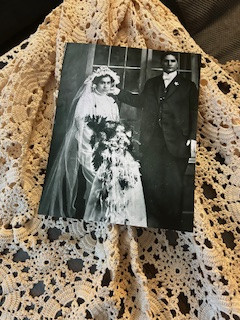
Whatever the details of the Italian Dulcenome orphan twins marrying the American Alberico brothers, the girls thrived in their new homeland. After being raised as orphans in a convent, they were finally blessed with families of their own. Palma and Daniel moved into a duplex in East Utica, a neighborhood filled with Alberico relatives. The Alberico boys ran a wholesale food business, so there was always food on the table. Palma put to use the skills she learned from the nuns in the Italian orphanage and raised a beautiful family of seven children.
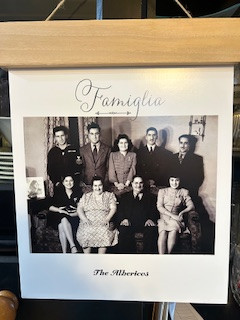
My mother-in-law remembers her grandmother always cooking fresh food for her family and for anyone who walked through her door. She remembers visiting her and seeing her homemade pasta laid out on a bedsheet on her bed to dry, and bins of beans soaking.
“The house smelled so good!” Emily said. “Grandma was always cooking or baking something. I especially remember her giant ravioli. They were amazing! Each one was a meal in itself, the size of a pizza.” I am thankful that Palma passed her cooking skills down to my mother-in-law. My children were raised with the best traditional Italian foods, cooked by their grandmother.
Aunt Joan explained that Palma’s entire life revolved around her home. “She was old-school. She barely left the house, and she spoke almost exclusively in Italian. She loved taking care of her family,” she said. “For Easter, she used to make special bread in the shape of a doll for each of her granddaughters.”
Before Palma passed away, she crocheted a bedspread for each of her fifteen granddaughters, a beautiful work of art she labored over even as she was losing her eyesight. Recently my mother-in-law gifted me with her treasured bedspread crocheted by her grandmother to cherish and pass down to the next generation.
Palma, the baby left on the steps of an orphanage in Italy, would be amazed to know that her family of seven children has grown into hundreds of descendants. She would be pleased to know that her family meets for a reunion each year to keep the family ties strong.
*This story includes memories shared from Palma’s daughter, Ermalinda Alberico Lewis and Palma’s granddaughters, Emily Alberico Lee, Joan Alberico Bigelow, and Lisa Lewis Leone.